
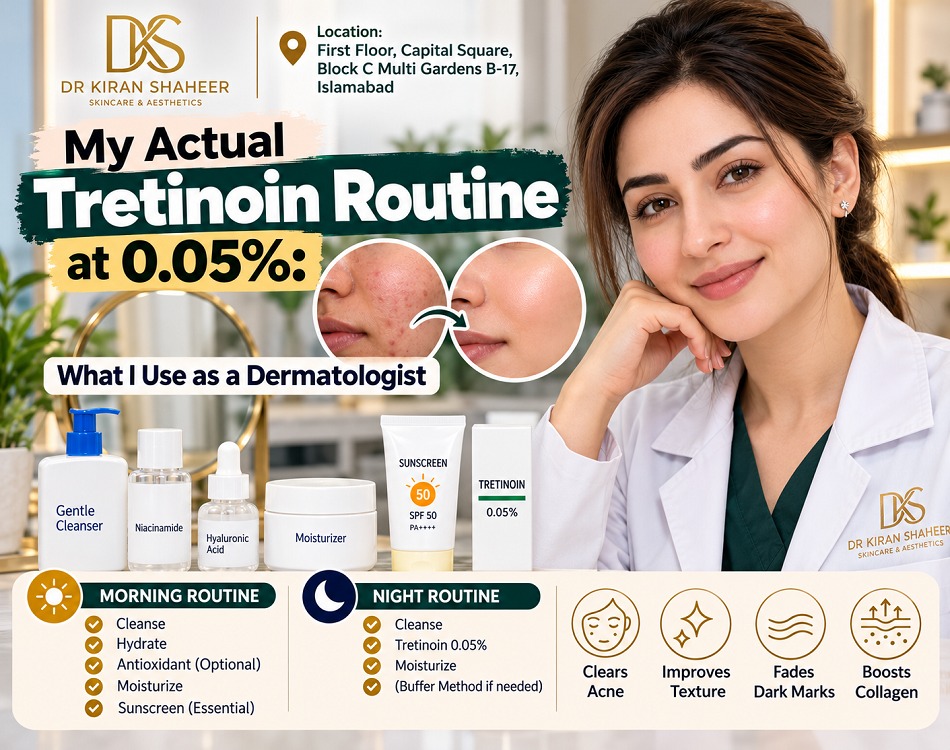
I get asked about tretinoin almost every day. Most people ask about starting it. Very few ask the better question: what do you actually put on your skin while using it, and why? This is my honest answer. Not the pamphlet version. The real one.
I have been using tretinoin for years. I have prescribed it to thousands of patients. My actual nighttime routine looks nothing like the standard “cleanse, apply, moisturize” advice you read everywhere online.
My routine is quieter and more intentional. It is built around letting tretinoin do its job without fighting my skin barrier in the process. I use it 2 to 3 nights per week as part of a deliberate skin cycling approach. On off-nights, I am not resting. I am actively rebuilding.
If you are just starting tretinoin, read my guide on the best moisturizer to use with tretinoin first. That covers the adjustment period basics. This post is for people who have already started 0.05% and want to understand how to build the full system around it.
- 0.05% is the clinical sweet spot: twice as potent as 0.025%, half the strength of 0.1%, with the strongest evidence for acne and anti-aging.
- Tretinoin works through four mechanisms in the skin simultaneously, not just exfoliation.
- I use the dry method. Beginners should use the sandwich method instead.
- My tretinoin nights run 4 steps: cleanse, wait 20 to 30 minutes, apply tretinoin, then layer barrier repair support.
- I use tretinoin 2 to 3 nights per week. Recovery nights are not passive. They are part of the system.
- SPF 50 every morning is not optional. It is the other half of what makes tretinoin work long-term.
Why 0.05% Is the Clinical Sweet Spot
Tretinoin comes in three standard strengths: 0.025%, 0.05%, and 0.1%. The number is the percentage of active retinoic acid in the formula. The strengths are not linear. Each jump changes both the results and the irritation profile in different ways.
The move from 0.025% to 0.05% is what clinical studies describe as the productive zone. You get significantly stronger anti-acne and anti-aging results with only a modest increase in side effects for most skin types. The jump from 0.05% to 0.1% is a different story. Irritation tends to outpace benefit at that level unless the skin has been on tretinoin for many months already.
0.05% is the strength used in nearly all the landmark photoaging trials, including the Weiss 1988, Olsen 1992, and Kang 2005 studies. If you have read research showing tretinoin reverses sun damage, the strength under discussion is almost always 0.05%. The Olsen 1992 data also showed that the efficacy curve for anti-aging largely flattens above 0.05%, meaning 0.1% is not measurably better for photoaging, just more irritating.
0.05% is the right strength for you if you have used 0.025% for at least 8 to 12 weeks with no significant peeling, and you want stronger results. It also suits people in their 30s and 40s starting tretinoin primarily for fine lines, uneven tone, or photoaging. For oily or combination skin, it offers a balanced potency for both acne and texture improvement.
Stick with 0.025% if you are a true beginner, have dry or sensitive skin, or live in a hot, dry climate where the baseline barrier stress is already high. Start lower, build tolerance, then step up. There is no benefit to rushing the strength increase.
How Tretinoin Actually Works in the Skin
Most guides describe tretinoin as “speeding up cell turnover.” That is true but incomplete. Understanding the full mechanism helps explain why the routine around it matters as much as the tretinoin itself.
Tretinoin binds to retinoic acid receptors inside the keratinocyte nucleus. These receptors regulate gene expression. Activating them does four things at the same time.
Dead corneocytes shed faster. Pores empty out. Comedones, the seed material of acne, lose their environment.
The keratin plug that turns a pore into a whitehead stops forming. This is the acne-prevention mechanism.
Type I and III procollagen production rises within weeks. Biopsies show measurable dermal collagen density increase after 6 to 12 months.
Pigment from melanocytes is delivered to keratinocytes less efficiently. This is how tretinoin fades dark spots and post-inflammatory hyperpigmentation.
This four-mechanism profile is why tretinoin is the only topical molecule with FDA approval for both acne and photoaging. No other prescription topical does all four jobs simultaneously. It is also why the routine built around it needs to support repair, not just tolerate the exfoliation.
Tretinoin vs. Retinol: What the Difference Actually Means
Retinol and tretinoin are both retinoids, but they are not the same thing. Retinol must be converted by your skin into retinoic acid in two biochemical steps. The conversion efficiency is roughly 1 in 20. So a 0.05% tretinoin cream delivers active retinoic acid immediately, while achieving the same delivered amount from retinol would require approximately a 1.0% retinol product, and even then, it takes longer to act because of the conversion window.
For meaningful clinical outcomes on acne or anti-aging, tretinoin is faster and more reliable. Retinol still works and is a good option for those who cannot tolerate tretinoin, but the comparison is not equal strength for equal strength.
Why I Use the Dry Method
There are three main ways to apply tretinoin. Each one changes how much active reaches the skin.
The sandwich method layers moisturizer before and after tretinoin. It slows absorption, reduces irritation, and is the right starting point for most people. The buffer method applies moisturizer first, then tretinoin on top. The dry method, which is what I use, means cleansing, waiting 20 to 30 minutes for skin to fully dry, and then applying tretinoin directly to bare skin.
Moisture on the skin increases tretinoin absorption. At 0.05%, that can shift from effective to irritating very quickly. Waiting for skin to be completely dry creates steadier, more predictable delivery. After years of daily use, my barrier handles this well. But this is not where I start patients.
The Wait Is Non-Negotiable
Damp skin absorbs more tretinoin and irritates faster. This is the most commonly skipped step and the most common cause of avoidable irritation I see in clinic. The key distinction is bone dry versus surface dry. Surface dry means the water you can feel is gone. Bone dry means the deeper layers have fully equilibrated too. That takes 20 to 30 minutes. Use the time to brush your teeth and wind down. Do not rush it.
My Tretinoin Night Routine, Step by Step
These are the exact steps I follow on tretinoin nights. No filler steps. Every product earns its place.
I start here every night, tretinoin or not. On tretinoin nights, I skip a second cleanser entirely. I want to preserve as much natural lipid as possible before the dry-down period. A cleansing balm with no foaming sulfates and no exfoliating agents works best. Massage for a full 60 seconds and remove gently. Look for formulas that include ceramides, centella, or panthenol in the ingredients. These actively support the barrier during the cleanse itself, not just after.
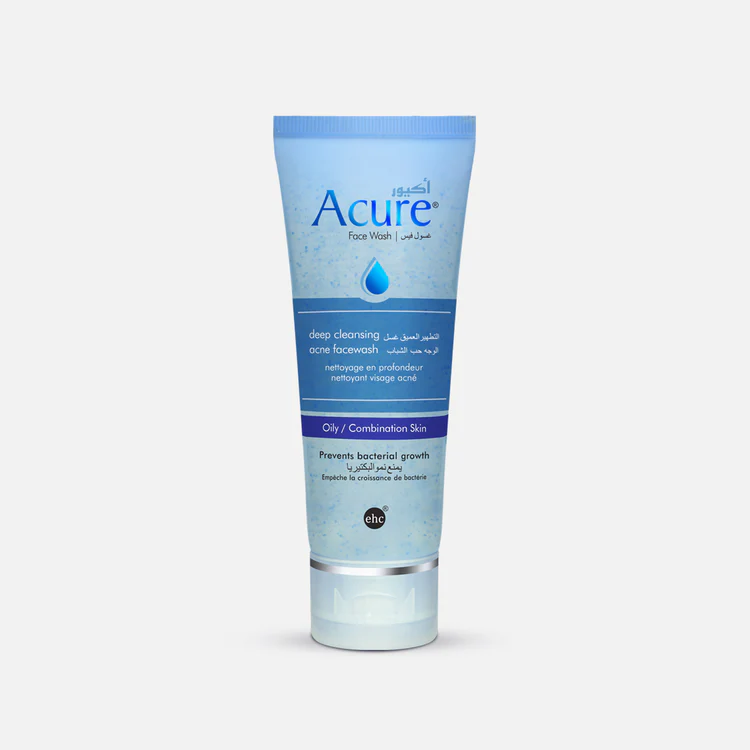
For patients who also manage acne-prone skin, I recommend the Acure Acne Facewash. It is antibacterial, free of harsh surfactants, and gentle enough to preserve barrier lipids before tretinoin application.
A single pea-sized amount for the entire face. Not per cheek. Not per zone. One pea total. More tretinoin does not produce more results. It produces more peeling and more irritation with no added benefit. Dot it across the forehead, both cheeks, nose, and chin. Blend upward and outward with light pressure. Avoid the eye contour, the corners of the mouth, and the nostrils where the skin is thinnest.
In Pakistan, tretinoin 0.05% is available over the counter under local brand names including A-Ret, Aleton, Actret, Tretix, and Trenoin. See the cream vs. gel comparison below for guidance on which vehicle suits your skin type.
⏱ Wait 5 minutes before layering anything elseThis is the step most people skip, and the one that changes everything. Tretinoin drives cell turnover. Without a repair partner on the same night, the barrier breaks down faster than it can rebuild. That leads to over-dryness, purging that lasts too long, and eventually, skipping tretinoin nights to recover. The repair layer prevents that cycle.
The ingredients that work best here are ceramides, madecassoside, centella asiatica, niacinamide, panthenol, and PDRN (polydeoxyribonucleotide) if accessible. PDRN stimulates fibroblast activity and supports collagen synthesis. It pairs with tretinoin by supporting the repair side of the renew-and-repair cycle rather than just adding more exfoliation pressure. While tretinoin drives turnover, PDRN helps the skin rebuild structural integrity on the same night.
For patients at my clinic managing barrier breakdown from tretinoin use, I recommend DERM REST Skin Barrier Repair Cream. It was formulated for post-laser and post-peel skin recovery, which is clinically similar to the state a heavy tretinoin night creates. It contains ceramides, hyaluronic acid, niacinamide, panthenol, and shea butter.
After years of use, my skin no longer needs a heavy final moisturizer on tretinoin nights. A well-formulated barrier repair layer provides enough support. If you are newer to tretinoin, have dry skin, or are currently in the retinization adjustment phase, add a dedicated ceramide moisturizer as a final step.
Keep it simple: ceramide-heavy, fragrance-free, and free of active ingredients. I recommend Emmo Light Moisturizing Lotion as the everyday option. It is lightweight, non-comedogenic, contains ceramides and hyaluronic acid, and has SPF 20 built in. For nights when the skin is visibly stressed or flaking, the richer DERM REST Cream performs better.
Tretinoin Cream vs. Gel at 0.05%: Which One to Choose
Both cream and gel deliver the same 0.05% tretinoin. The difference is the vehicle, not the strength. The vehicle changes how quickly the active absorbs and how the formula feels on your skin.
| Feature | Cream 0.05% | Gel 0.05% |
|---|---|---|
| Best skin type | Dry to normal skin | Oily to acne-prone skin |
| Absorption speed | Slower, more moisturising | Faster, dries quickly |
| Irritation potential | Lower (cream base buffers) | Slightly higher (alcohol/glycol base) |
| Good for beginners | Yes | Cautiously |
| Common brands in Pakistan | A-Ret cream, Actret cream, Tretix | A-Ret gel, Atralin gel |
| Better for acne | Good | Preferred |
| Better for anti-aging | Preferred | Good |
Pick the vehicle based on your skin type, not on perceived strength. There is no difference in potency between cream and gel at the same percentage. The reason gel can feel stronger is the alcohol or propylene glycol base, which irritates more easily, not because it delivers more retinoid.
How Often to Use Tretinoin 0.05%: The Frequency Ramp
One of the most common mistakes I see is starting at too high a frequency. The skin needs time to adjust. Starting slow and building up consistently over 12 weeks produces better long-term results than nightly use from week one.
| Weeks | Frequency | What to Watch For |
|---|---|---|
| 1 to 2 | 2 nights per week (e.g. Mon, Thu) | Mild tingling is normal. Flaking should be minimal at this stage. |
| 3 to 4 | 3 nights per week (Mon, Wed, Fri) | First purge wave may begin. Some redness and dryness around the nose and mouth. |
| 5 to 8 | Every other night | Cheeks may peel slightly. Drop back one tier if barrier visibly flares. |
| 9 to 12 | 5 to 6 nights per week | Acne clearance becoming visible. Skin starting to feel more normal post-cleanse. |
| 12 and beyond | Nightly if tolerated | Most experienced users settle here long-term. Skin cycling still recommended. |
If your skin is peeling hard at any stage, drop one frequency tier for two weeks before stepping back up. There is no benefit to pushing through a damaged barrier. Drop frequency before you drop strength. Three nights a week at 0.05% consistently outperforms nightly use of 0.025% over a full year.
My Full Weekly Skin Cycling Schedule
I never use tretinoin every night by default. This is a deliberate clinical strategy, not caution. Skin cycling gives the barrier genuine recovery windows while still delivering cumulative retinoid results across the week. The patients who skip recovery nights are usually the ones who tell me tretinoin is too harsh for their skin. It is not the tretinoin. It is the missing recovery.
- Gentle cleansing balm
- Wait 20 to 30 min (bone dry)
- Tretinoin 0.05%
- Wait 5 min
- Barrier repair layer
- Optional final ceramide moisturizer
- Gentle cleansing balm
- Low-strength AHA (month 3+)
- Barrier-supporting moisturizer
- Gentle cleansing balm
- Barrier repair ampoule or cream
- Rich ceramide moisturizer
- Nothing else
Recovery nights are when skin catches up. It re-layers lipids, reduces transepidermal water loss, and prepares the barrier for the next active cycle. Skipping them is the single most common form of self-sabotage I see in tretinoin users. Simplicity on those nights is the entire point. One cleanser and one good moisturizer. That is the recovery protocol.
What I Use the Morning After a Tretinoin Night
The morning routine is not separate from the tretinoin system. It is the second half of it. Tretinoin increases photosensitivity significantly. Without morning SPF, the skin you are rebuilding at night gets damaged again the next day. That is why long-term tretinoin users who skip sunscreen do not see the results they expect.
What Makes a Good Sunscreen for Tretinoin Users
Not every SPF 50 works equally well on tretinoin-sensitized skin. Avoid sunscreens with fragrance, alcohol, or heavy occlusive filters if your skin is still in the adjustment phase. Look for mineral filters (zinc oxide, titanium dioxide) or well-formulated chemical sunscreens designed for sensitive skin. In Pakistan’s climate, a lightweight, non-comedogenic formula matters especially in summer. UV index in most of Pakistan stays high year-round, including in winter and on overcast days.
Avoid physical scrubs, exfoliating acids, and retinol-containing products in the morning entirely. Tretinoin-sensitized skin is more reactive than usual, especially in the first 12 weeks. Keep the morning routine as simple and gentle as possible.
What the First 16 Weeks Actually Look Like
Retinization is the dermatology term for the adjustment period when your skin adapts to tretinoin. Most people who quit tretinoin in the first 8 weeks do so because nobody explained this phase to them in advance. The discomfort has a name, a timeline, and an end point.
Skin feels tight. Mild flaking around the corners of the mouth and nose. Pores may look slightly larger as plugs begin to loosen. This is all expected and normal.
Comedones already forming below the surface push up and resolve faster than usual. Skin can look worse before it looks better. This is not failure. It is the treatment working. Do not stop.
Acne lesions reduce in size and frequency. Texture starts smoothing. Post-inflammatory pigmentation begins to fade. The barrier starts tolerating tretinoin more easily.
Visibly clearer skin. Fine lines around the eyes look less etched. Skin tone more even. Barrier sensitivity decreasing noticeably.
Photoaging response peaks. Pigment evens out significantly. Pore appearance reduces. Collagen density measurably increasing. This is where long-term users see results that make tretinoin the most studied anti-aging prescription topical ever written.
Tretinoin for Hyperpigmentation and Dark Spots
Tretinoin 0.05% is one of the three components of the Kligman triple combination, which is the gold-standard prescription protocol for melasma and stubborn post-inflammatory hyperpigmentation. The other two components are hydroquinone 4% and a low-potency corticosteroid. Measurable lightening typically appears within 8 to 12 weeks with the full triple combination.
If you are using tretinoin 0.05% alone for hyperpigmentation, expect a slower but real result. Visible fading usually takes 4 to 6 months. Daily SPF is not optional here. Without it, the pigment re-darkens from UV exposure and undoes the progress tretinoin is making. In Pakistan’s high UV environment, broad-spectrum SPF 50 every morning is especially critical for anyone treating pigmentation with tretinoin.
Side Effects and How to Manage Them
Side effects from tretinoin 0.05% fall into three categories. Knowing which category you are in changes what you do next. Most side effects in the first 8 to 12 weeks are expected and dose-dependent. They fade as the skin adjusts.
- Redness and tightness
- Dryness and flaking
- Mild stinging on application
- Purging in weeks 3 to 6
- Increased skin sensitivity
- Eczema-like flares
- Persistent burning sensation
- Severe peeling beyond week 8
- Hyperpigmentation paradox (more relevant in Fitzpatrick IV to VI skin tones)
- Hives or blistering
- Eyelid swelling
- Rash spreading beyond application area
- Severe burning that does not reduce with frequency drop
Five Practical Fixes for Common Irritation
Before quitting tretinoin because of irritation, try these adjustments in order.
Drop frequency first. Three nights a week at 0.05% beats nightly use of 0.025% over a year. Drop one tier on the ramp table and hold for two weeks before stepping back up.
Switch to the sandwich method. If you are using the dry or buffer method, go back to moisturizer before and after tretinoin. This reduces absorption and irritation without meaningfully reducing efficacy.
Stop all acid actives. Glycolic, salicylic, mandelic, and lactic acid all add exfoliation pressure. Remove them entirely for the first 12 weeks. Reintroduce only after your barrier is stable.
Add niacinamide 5% in the morning. It reduces redness, supports barrier function, and helps manage the visible inflammation that comes with retinization. It works differently from tretinoin and does not compete with it.
Switch to a fragrance-free SPF. Tretinoin-irritated skin is hyperreactive. A perfumed sunscreen that you tolerated before tretinoin may now cause stinging. Switch to a simple, fragrance-free mineral SPF during the adjustment period.
The Three Mistakes I Address Most Often in Clinic
After years of prescribing tretinoin, certain patterns repeat. These are the three I correct most often.
Piling on moisturizer immediately after tretinoin dilutes the active before it absorbs. Then on recovery nights, when the barrier actually needs intensive repair, patients use nothing at all. The logic needs to be flipped. Minimal layering on tretinoin nights. Rich, intentional moisturizing on recovery nights. If your skin is already visibly damaged from dryness, my guide on moisturizer for tretinoin peeling has a targeted recovery plan.
Weeks 4 to 8 are where most people stop. The purge, the flaking, the heightened sensitivity. All of it is normal during retinization. The patients who push through at the right frequency consistently see real results at the 3 to 6 month mark. If your barrier is genuinely struggling, the solution is to drop frequency, not quit. Three nights a week at the right strength with proper barrier support always outperforms quitting and restarting.
Tretinoin increases photosensitivity significantly. One unprotected afternoon can undo weeks of progress and worsen the very pigmentation you are trying to treat. Sunscreen is not a finishing touch. It is a non-negotiable part of the tretinoin system. Use SPF 50 every morning, including during winter and on cloudy days. Pakistan’s UV index remains high year-round. There are no safe days to skip it while using tretinoin.
What to Use With Tretinoin and What to Avoid
The rule is simple. Keep tretinoin nights as clean as possible. Let tretinoin be the only active doing significant work that night. Everything else should support the barrier, not compete with the active or add more exfoliation pressure on top of it.
- Ceramides
- Hyaluronic acid
- Glycerin
- Niacinamide (after tretinoin settles)
- Panthenol (Pro-Vitamin B5)
- Madecassoside
- Centella asiatica
- PDRN (polydeoxyribonucleotide)
- Peptides
- AHAs: glycolic, lactic, mandelic acid
- BHAs: salicylic acid
- Benzoyl peroxide (same night)
- Vitamin C (morning only)
- Citric acid
- Fragrance and essential oils
- Denatured alcohol
- Physical scrubs
A Note on Madecassoside
Madecassoside is one of my favourite supporting ingredients for tretinoin users. It is anti-inflammatory, barrier-repairing, and calming. It belongs to the centella asiatica family of ingredients, which has decades of use in wound healing and post-procedure skin care. For anyone in the retinization phase experiencing redness and sensitivity, adding a madecassoside-containing product on tretinoin nights and recovery nights meaningfully shortens the adjustment period.
Niacinamide and peptides also pair well with tretinoin. Apply tretinoin first and let it settle for 5 minutes before adding niacinamide. This prevents dilution of the retinoid rather than addressing any chemical incompatibility. Vitamin C belongs in the morning only. Pairing it with tretinoin at night adds no benefit and increases irritation risk.
Frequently Asked Questions
Can I use tretinoin 0.05% every night?
Most dermatologists recommend building up gradually: 2 nights per week for the first two weeks, then 3 nights, then every other night, and eventually nightly only after 12 or more weeks of stable tolerance. There is no benefit to rushing. Consistency over six months always beats a high frequency held for six weeks. Many long-term tretinoin users prefer 2 to 3 nights per week permanently because the skin cycling approach produces better results with less cumulative barrier damage.
Is tretinoin 0.05% stronger than retinol?
Yes, significantly. Retinol must be converted by your skin into retinoic acid in two biochemical steps. The conversion efficiency is roughly 1 in 20. So 0.05% tretinoin delivers active retinoic acid immediately, while achieving an equivalent delivered dose from retinol would require approximately a 1.0% retinol product, and even that takes longer to act. For meaningful clinical outcomes on acne or anti-aging, tretinoin is faster and more reliable. Retinol remains a useful option for those who cannot tolerate tretinoin, but the two are not equivalent.
What is the difference between tretinoin cream and gel at 0.05%?
Same molecule, same concentration, different vehicle. Cream is more moisturising and better suited to dry or normal skin. Gel dries faster and is preferred for oily or acne-prone skin. Gels can feel slightly more irritating because they often contain alcohol or propylene glycol in the base, not because they deliver more retinoid. There is no strength difference between them at the same percentage. Pick by skin type, not by perceived potency.
Can I use tretinoin 0.05% under my eyes?
Yes, but carefully. Apply it to the orbital bone and the crows-feet area only, not directly to the eyelid or the hollow under the eye. Start at one night per week in that area and ramp up more slowly than the rest of the face. The skin around the eye is significantly thinner and more reactive. I recommend using the sandwich method for the eye area even if you have switched to the dry or buffer method for the rest of the face.
Why does my moisturizer burn after applying tretinoin?
This usually means the tretinoin has not fully absorbed before you layered on top of it. Wait at least 5 minutes after tretinoin before applying anything else. It can also mean your moisturizer contains an ingredient that reacts with tretinoin-sensitized skin, such as citric acid, alcohol, or fragrance. Switch to a simple, fragrance-free ceramide moisturizer. If stinging persists after making both changes, read my guide on moisturizer for tretinoin peeling.
How long until I see results from tretinoin 0.05%?
Acne lesions typically reduce in size and frequency between weeks 6 and 10. Texture starts smoothing and pigmentation begins fading around the same time. Visible clearer skin usually appears between weeks 10 and 16. The full photoaging and collagen response builds over 6 months and beyond. Do not judge tretinoin before month 3. Most visible improvement in fine lines and overall skin quality happens between months 3 and 6. The landmark photoaging trials all used 6 to 12 month endpoints for a reason.
Can I use niacinamide with tretinoin on the same night?
Yes. The older concern about niacinamide converting to niacin and causing flushing has been largely disproven at skincare concentrations. Apply tretinoin first and let it settle for 5 minutes before adding niacinamide. This prevents dilution of the retinoid rather than addressing any chemical reaction. Niacinamide at 5% reduces redness, supports barrier function, and helps manage the visible inflammation during retinization, making it a genuinely useful addition on tretinoin nights.
Should I use madecassoside alongside tretinoin?
Yes, it is one of the best supporting ingredients for tretinoin users. Madecassoside is anti-inflammatory, barrier-repairing, and calming without adding any exfoliation pressure. It belongs to the centella asiatica family of ingredients used in wound healing and post-procedure recovery. Using it on tretinoin nights and recovery nights meaningfully shortens the adjustment period and reduces the redness associated with retinization. It does not interfere with tretinoin’s mechanism in any way.
What should I do if my skin is peeling badly?
Drop frequency first before reducing your strength. Switch to the sandwich method if you are currently using the dry or buffer method. Add a richer ceramide moisturizer on recovery nights. Stop all acid actives immediately. If the peeling is severe and not improving after two weeks of these adjustments, take a full one-week break from tretinoin, then restart at a lower frequency. My guide on the best moisturizer for tretinoin peeling has a targeted recovery protocol.
When should I move up from 0.05% to 0.1%?
Only after 9 to 12 months of stable, mostly nightly use of 0.05% with no significant irritation, and only if you have a clear reason such as a plateau in acne clearance, persistent deep wrinkles, or stubborn melasma supervised by a doctor. Many people never need to move up. 0.05% used consistently over years outperforms a few months of 0.1% punctuated by barrier crashes and recovery breaks. The Olsen 1992 photoaging data also showed the efficacy curve for anti-aging largely flattens above 0.05%, meaning the higher strength adds irritation, not meaningfully better results.
Which moisturizer is better with tretinoin: Vanicream or CeraVe?
Both are well-formulated, fragrance-free options. CeraVe Moisturizing Cream contains ceramides, hyaluronic acid, and niacinamide, making it slightly more active in barrier support. Vanicream is simpler with fewer ingredients, which makes it the better choice for extremely sensitized skin that reacts to almost everything. In Pakistan, both can be difficult to source reliably and at reasonable prices. Locally available alternatives like Emmo Light Lotion and DERM REST Cream are formulated for the same purpose and are readily accessible through the clinic.
Can I use tretinoin while pregnant or breastfeeding?
No. Tretinoin is not recommended during pregnancy or breastfeeding due to potential risk to the fetus. Stop tretinoin if you are planning to conceive and discuss alternatives with your doctor. Safe options during pregnancy for both acne and pigmentation include azelaic acid and niacinamide. Do not restart tretinoin without medical guidance after delivery, especially if breastfeeding.
The Shift That Changes Tretinoin From a Battle to a System
When you pair tretinoin with something that actively supports repair, you stop fighting your own skin barrier and start working with your skin’s natural cycle. Tretinoin is the catalyst. Barrier support is the recovery. They are not competing. They are completing each other.
The patients who get the best long-term results are not the ones who use tretinoin most aggressively. They are the ones who build a consistent system around it. A clean gentle cleanser, a structured weekly cycling schedule, real moisturizer on recovery nights, and SPF 50 every morning without exception.
Start slow. Build the full system. Stay consistent across months, not just weeks. That is the entire strategy.
Have a question about your own tretinoin routine? Drop it in the comments below. I read every one.
Book a consultation at the clinic. I will assess your skin type, current products, and tretinoin strength and build a routine specific to your skin and Pakistan’s climate.
Book a Consultation