
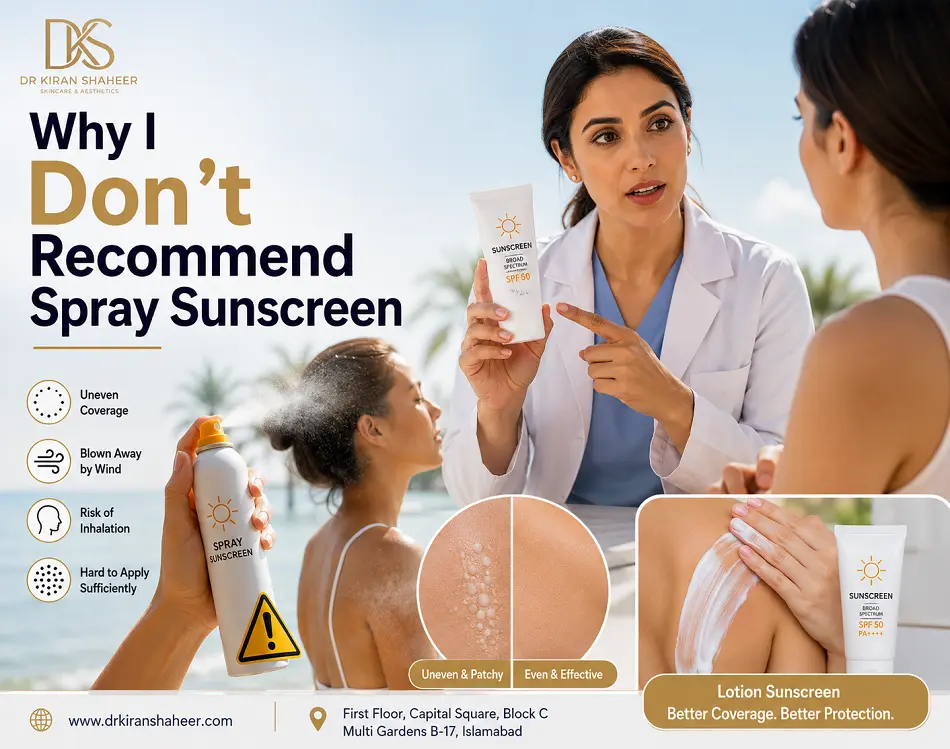
Every summer, I see the same pattern in my clinic. A patient comes in with a sunburn, dark patches, or worsening pigmentation. They used sunscreen. They reapplied it. And the damage still came. Nine times out of ten, when I ask what they used, the answer is spray sunscreen.
Spray sunscreen has a marketing problem. It looks convenient. It feels like enough. You spray, you move on. But what your skin actually receives is a fraction of the protection printed on the label. In Pakistan’s climate, where the UV index stays dangerously high for six months of the year, that gap is not minor. It is real skin damage.
I am Dr. Kiran Shaheer, an aesthetic doctor based in Islamabad. I want to explain exactly why spray sunscreen fails you, what the science says, and what you should use instead. This is not about being anti-convenience. It is about making sure your sunscreen actually works.
Quick Summary
- Most people apply only 25% of the dose needed when using spray sunscreen
- Spray gives invisible, uneven coverage with no way to confirm protection
- Inhaling aerosol sunscreen poses real respiratory risk, especially for children
- Spray cans are flammable and many formulas contain harmful chemicals
- Lotion, cream, and stick sunscreens give measurable, reliable protection
- Pakistan’s UV index is extreme — your sunscreen format must match that reality
Why Spray Sunscreen Became So Popular
Spray sunscreens now represent about 26% of all SPF products sold. The appeal is real. No sticky hands. No white cast. No rubbing. Just point and spray. For parents managing children, or anyone reapplying over makeup, it sounds like the perfect solution.
But popularity is not the same as protection. A product can sell millions of units and still fail at its one job. When sun protection fails, the result is UV damage. And UV damage means accelerated aging, hyperpigmentation, and increased cancer risk over time.
The issue is not that spray sunscreen is inherently bad. The issue is that its design makes correct use nearly impossible in real-world conditions. Almost nobody uses it right. And the consequences show up on the skin years later.
Pakistan’s UV Reality: Why This Matters More Here
Before getting into the specific problems, it is worth understanding the UV environment in Pakistan. The UV index in Islamabad, Lahore, and Karachi regularly hits extreme levels from April through September. Extreme UV means unprotected skin begins to burn in under 15 minutes. This is not a Western-climate context where spray sunscreen’s shortcomings might be slightly more forgiving. Here, the margin for error is thin.
Pakistan UV Index by Season (Islamabad / Lahore)
At UV index 10 and above, you need sunscreen that delivers its full stated protection. Spray sunscreen, as we will see, routinely delivers far less than that.
Reason 1: You Are Not Applying Nearly Enough
The American Academy of Dermatology recommends one full ounce of sunscreen to cover all exposed skin. That is about a shot glass worth. For the face and neck alone, you need a nickel-sized amount. For arms, legs, and the back, you need several teaspoons per section.
To approach the recommended dose using a spray, you need to hold the can over each body section and spray continuously for five to six full seconds. Almost nobody does this. People do a quick sweep, feel a light mist, and assume they are covered. They are not.
The SPF number on any bottle is measured under controlled lab conditions using a precise, standardised amount of product. If you apply a quarter of that amount, you do not get a quarter less protection. You get exponentially less. A label that says SPF 50 may deliver real-world protection closer to SPF 10 or lower. That is where sun damage starts.
Reason 2: You Cannot See Where It Has Gone
Lotion sunscreen is visible. You can see where you have applied it, feel where you have missed, and confirm full coverage before you head out. Spray sunscreen dries in seconds and leaves no visible trace. You have no way to know if you have covered your skin properly. That is a fundamental design flaw for a protection product.
Correct spray coverage depends on how far you hold the can from your skin, how slowly you move your hand, and how long you spray each section. Any small change in those variables creates an unprotected gap. And unprotected gaps on sun-exposed skin accumulate into real damage over months and years.
Wind Defeats Spray Sunscreen Entirely
Most people apply sunscreen outdoors. At the beach, on a cricket ground, in a garden, at a market. These are environments with moving air. Even a light breeze is enough to redirect aerosol mist away from your skin. The particles are too light to land where you aim them.
Studies have shown that a mild wind can send a significant portion of spray sunscreen sideways rather than onto the skin. You are spraying. You feel the mist. But half of it has landed on your towel, your chair, or the person next to you. Your skin is exposed.
Reason 3: You Are Breathing It In
This is the concern that receives the least public attention and deserves the most.
Aerosol spray sunscreens contain propellants. These are compressed gases like propane, butane, and isobutane that push the product out of the can. Research from Australia found that a standard aerosol sunscreen can be anywhere from one-third to 60% propellant by composition. That means a large share of what comes out of that can contains no sun protection at all. It is just gas.
When you spray this mist over your body, you breathe it in. The aerosol particles are small enough to travel deep into the lungs. The FDA proposed testing requirements to confirm that aerosolised sunscreen cannot be inhaled into the deep lung. As of 2025, that testing has not been completed.
Both the FDA and the American Academy of Dermatology advise people to avoid inhaling spray sunscreen. The problem is practical: how do you avoid inhaling something you are spraying in a cloud around your body?
Children Face the Greatest Risk
Children breathe faster than adults. Their lungs are still developing. This makes inhalation exposure proportionally higher and potentially more harmful. Consumer Reports has recommended against aerosol spray sunscreen for children specifically because of respiratory risk. The AAD echoes this guidance.
The product marketed as the easiest solution for active, squirmy children is the one that carries the most significant respiratory risk for them. This is a direct conflict between convenience and safety.
Benzene Contamination in Spray Sunscreens
Between 2021 and 2023, there were multiple recalls of spray sunscreens due to benzene contamination. A Valisure laboratory study tested 78 sunscreen products and found that 27% had detectable benzene levels. Some contained up to three times the FDA’s concentration limit. Aerosol formats were among the affected products. Benzene is a known carcinogen linked to blood disorders and weakened immune function.
This is not a theoretical risk. These were real products, on real shelves, used by real people before the recalls happened.
Reason 4: It Should Never Go Directly on Your Face
Your face is the most sun-exposed part of your body. It is also the area most commonly under-protected by spray sunscreen, because spraying directly on the face is genuinely unsafe.
The FDA does not recommend applying spray sunscreen directly to the face. The aerosol mist cannot be aimed precisely. It risks entering the eyes, nose, and mouth. Chemical filters and propellants in the eyes cause significant irritation. In the airway, they cause respiratory discomfort and can trigger reactions in people with asthma.
Dermatologists who do allow spray use will tell you: spray it into your palm, then apply with fingertips. But at that point you are using it exactly like a lotion, with the added waste of propellant and the inhalation risk during transfer. A proper lotion or cream sunscreen does the same job better and more safely from the start.
Reason 5: Spray Sunscreen Is Flammable
The propellants in aerosol sunscreens are flammable gases. This is printed on every can. Most people never read it.
The flammability window exists during application and for several minutes after, while propellant evaporates from the skin. Standing near a barbecue, lighting a stove, or sitting close to a candle during that window creates real fire risk. There are documented burns from this exact scenario.
In Pakistan, outdoor gatherings commonly involve open flames for cooking. Spray sunscreen and those settings are a genuinely dangerous combination. This is not a hypothetical warning. It is a label that almost no one reads.
Reason 6: The Chemical and Environmental Picture
Many spray sunscreens use chemical UV filters like oxybenzone and octinoxate. These filters have been shown to absorb into the bloodstream through skin contact. The inhalation route makes bloodstream absorption faster and higher than topical use alone.
The same chemical filters that enter your body also enter waterways through sweat and washing. Oxybenzone has been shown to damage coral reefs. Hawaii, Key West, the US Virgin Islands, Aruba, and several Pacific islands have banned sunscreens containing it for this reason.
The propellant gases released by aerosol cans go directly into the atmosphere with every use. The FDA proposed aerosol-specific safety testing in 2019. Those rules remain unfinalized. That regulatory gap means the category is operating on incomplete safety data while remaining widely sold and commonly used.
| Factor | Spray | Lotion / Cream | Stick |
|---|---|---|---|
| Coverage Control | ✗ Guesswork | ✓ Full control | ✓ Good control |
| Dose Accuracy | ✗ Hard to measure | ✓ Easy to measure | ✓ Moderate |
| Safe for Face | ✗ Not directly | ✓ Yes | ✓ Yes |
| Safe for Children | ✗ Inhalation risk | ✓ Yes | ✓ Ideal |
| Works in Wind | ✗ Product drifts | ✓ Not affected | ✓ Not affected |
| Flammability Risk | ✗ Yes | ✓ None | ✓ None |
| Broad Spectrum Options | ⚠ Limited | ✓ Widely available | ✓ Widely available |
| Reef Safe Formulas | ✗ Limited | ✓ Many options | ✓ Many options |
| Reapplication | ⚠ Over makeup only | ✓ Easy | ✓ Very easy |
What Should You Use Instead?
You do not need a complicated routine. You need a sunscreen format that gives you reliable, measurable, visible coverage. That means lotion, cream, or stick. All three are better than spray in every clinically relevant way.
Lotion and Cream Sunscreens: The Recommended Standard
Lotion sunscreens are the most widely recommended format by dermatologists worldwide. You can see exactly how much you are applying. You feel where it has gone. You rub it in and you have confirmation of coverage. They work for every skin type and are available in formulas for oily, dry, sensitive, and acne-prone skin.
For Pakistan’s climate, use a broad-spectrum sunscreen with SPF 50 as the daily minimum. SPF 30 is the international floor. But given the UV index levels from May through September here, SPF 50 or higher gives you a real safety margin. Look specifically for broad-spectrum labelling, which confirms UVA protection alongside UVB. UVB causes burning. UVA causes deeper aging and pigmentation. You need both blocked.
How to Read the Label: Key Terms Decoded
What the Sunscreen Label Actually Means
Doctor-Recommended Sunscreens from Dr. Kiran Shaheer
These are the products I recommend to patients based on clinical experience with skin types common in Pakistan. They are selected for UV filter stability, skin compatibility, and real-world performance in high-UV conditions.
Anti-UV Cream
Broad-spectrum daily UV protection. Lightweight, non-greasy formula. Suitable for most skin types and designed for everyday use in Pakistan’s climate.
View ProductUnsun Sunblock with Glutathione
UV protection combined with glutathione for active skin brightening. Best for patients managing hyperpigmentation, tan, or uneven skin tone alongside sun protection.
View ProductUV Matt SPF 60 Broad Spectrum
High-protection SPF 60 with a matte, anti-tan finish. Best for oily and combination skin types, especially during Pakistan’s summer months with extreme UV exposure.
View ProductWhich Sunscreen Suits Your Skin Type?
Sunscreen Sticks: Best for Children and On-the-Go Reapplication
Stick sunscreens have a thicker consistency that will not drip into the eyes. They apply precisely on small faces, ears, and the back of the neck. For children, sticks remove the guesswork. A child can even learn to apply their own by drawing shapes on their skin and then rubbing them in. No aerosol mist. No inhalation risk.
For adults, a stick in your bag or pocket makes midday reapplication easy without disturbing makeup or needing to find a sink to wash your hands first.
If You Absolutely Must Use Spray Sunscreen
Some situations make spray feel unavoidable. Reapplying over makeup. A travel-size product that is all you have. A moment when lotion is not accessible. If spray is genuinely your only option, here is how to make it as safe as possible.
-
Spray until your skin looks visibly wet. A light mist is not a protective layer. Keep spraying each section until you can see the product sitting on the skin surface. This is the minimum dose that approaches real protection.
-
Rub it in immediately. Every time. No exceptions. Ignore any label that says “no rub.” Rubbing ensures the product contacts every part of the skin surface and closes coverage gaps. Spray left unrubbed sits in spots and leaves others bare.
-
Never spray in wind or open air. Apply inside or in a fully sheltered spot before heading out. Wind redirects mist away from your skin. Half your product in the air means half your protection gone.
-
Never spray directly on your face. Spray into your palm. Apply with fingertips. For the face, always use a lotion, cream, or stick. Never spray a child’s face directly under any circumstances.
-
Hold your breath during application. Move away before inhaling. Do not spray in a confined space. The aerosol cloud disperses slowly. Give it several seconds before breathing normally again.
-
Stay away from open flames for at least five minutes after applying. Propellants remain on the skin surface while evaporating. No barbecue. No gas stove. No candles. This is a real fire risk, not just a label warning.
-
Reapply every two hours without exception. Spray degrades faster in high-UV conditions. Every 80 minutes when swimming or sweating. After towel-drying, always reapply regardless of water resistance claims.
Frequently Asked Questions
The Bottom Line
Spray sunscreen is not giving you the protection you think it is. The dose is too low. The coverage is invisible and uneven. The inhalation risk is real. In Pakistan’s extreme UV conditions, that gap between what the label promises and what your skin receives is wide enough to cause lasting damage.
Switching to a lotion, cream, or stick sunscreen is not a complicated change. It takes the same thirty seconds. But it gives your skin the actual protection it needs, every single day.
Explore the doctor-recommended options available at our clinic: the Anti-UV Cream for everyday protection, the Unsun Sunblock with Glutathione for brightening and sun protection together, and the UV Matt SPF 60 Broad Spectrum for high-UV outdoor days. All three are selected for real performance in real conditions.
— Dr. Kiran Shaheer, Aesthetic Doctor, Islamabad