
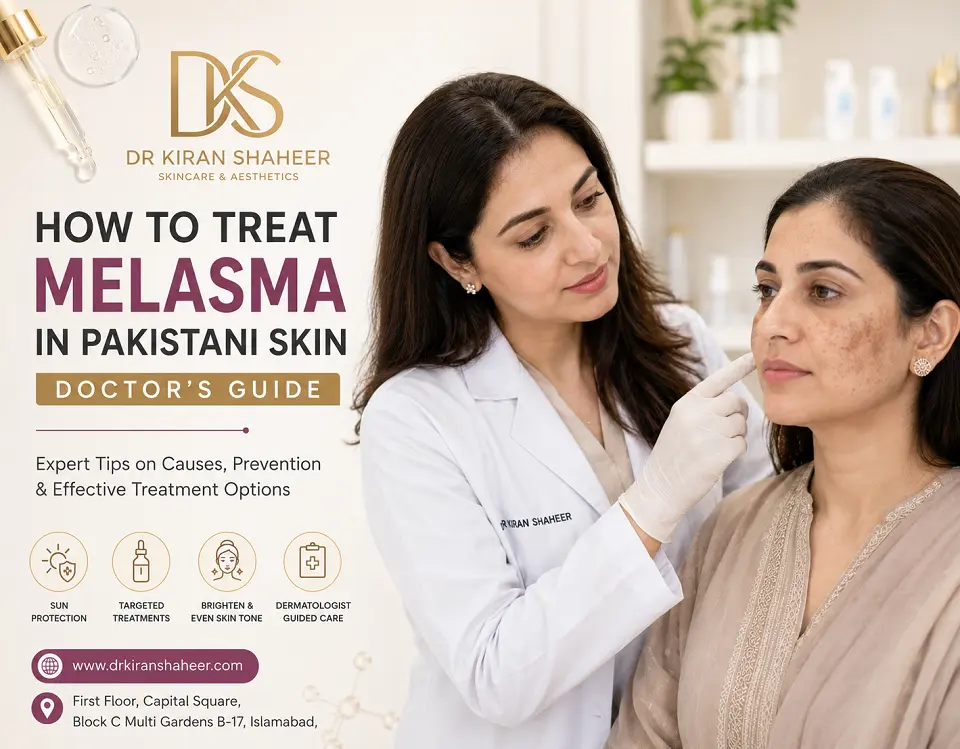
Melasma is one of the most common complaints I hear at my clinic. Patients come in with brown or grey patches on their cheeks, forehead, and upper lip. Most have already tried several creams. Most say the same thing: “Doctor, nothing is working.” The problem is not that melasma cannot be treated. The problem is the wrong approach. This guide explains the right one.
What Is Melasma?
Melasma is a form of hyperpigmentation. It appears as flat, brown, or grey-brown patches on the face. It most commonly affects the cheeks, nose bridge, forehead, and the area above the upper lip.
It is not a rash. It is not an infection. It is excess melanin production triggered in specific skin cells called melanocytes. Melasma affects women far more than men. It is especially common during pregnancy, while using hormonal contraceptives, and during perimenopause.
Why Pakistani Skin Is More Prone to Melasma
Pakistani skin falls in Fitzpatrick skin types III to V. Our melanocytes are more active. They produce pigment more readily in response to triggers. Three main triggers drive melasma in Pakistan.
Sun exposure. UV rays directly stimulate melanin production. Pakistan has some of the highest UV index readings in the world, especially between March and October. Even 10 minutes of unprotected sun can worsen active melasma.
Hormonal changes. Estrogen and progesterone stimulate melanocytes. Pregnancy, oral contraceptive pills, and hormonal IUDs are common triggers in our patient population.
Heat. Visible light and infrared radiation from heat also trigger pigmentation, independent of UV. In Pakistan’s summers, even indirect heat exposure can darken melasma patches. This is why melasma often flares in summer even on overcast days.
Why Melasma Is Difficult to Treat
Melasma sits in two layers of the skin. Epidermal melasma is closer to the surface and responds better to topical treatment. Dermal melasma sits deeper and is harder to reach.
Most patients have mixed-type melasma. This is why results take time. Stopping treatment early almost always leads to relapse.
Important: There is no permanent cure for melasma. It can be controlled and significantly faded. But without ongoing maintenance, especially consistent sun protection, it returns. Understanding this upfront saves a lot of frustration.
The Right Treatment Approach
Step 1 — Start With Sun Protection
No treatment works without daily SPF. This is not optional. It is the foundation of every melasma protocol.
UV rays are the primary driver of melanin production. If you are using a brightening cream at night and going outdoors without SPF in the morning, the cream’s progress is undone every single day.
Use a broad-spectrum SPF 60, applied every morning, regardless of cloud cover. Reapply every two hours if you are outdoors. A matte, oil-free formula works best for daily use in Pakistan’s humid climate.
Step 2 — Use a Targeted Depigmenting Agent
The gold standard ingredient for melasma is hydroquinone. It works by inhibiting tyrosinase, the enzyme required for melanin production. Concentrations of 2% to 4% are commonly used. Use it in treatment cycles of three to four months, under medical guidance.
Other effective depigmenting ingredients include kojic acid, azelaic acid, niacinamide, and alpha arbutin. Each works differently and suits different skin sensitivities.
The formulations below are suitable for pigmentation management in Pakistani skin. Both are designed for daily use and address the surface-level melanin responsible for visible darkening.
Step 3 — Add a Retinoid at Night
Retinoids increase skin cell turnover. This pushes pigmented cells to the surface faster, where they are shed. Retinoids also help depigmenting agents absorb more effectively.
Start with retinol two to three nights per week. Increase to nightly use over four to six weeks as your skin adjusts. Always use retinoids at night. They degrade in sunlight and increase UV sensitivity.
Step 4 — Be Patient and Consistent
Epidermal melasma responds in eight to twelve weeks of consistent use. Dermal melasma takes four to six months or longer. The most common mistake is stopping after two or three weeks because no change is visible. Melanin cycles slowly. Results require patience.
What to Avoid
Aggressive scrubbing. Physical exfoliation irritates the skin barrier and triggers more melanin production. Avoid face scrubs and rough exfoliants if you have active melasma.
Unknown whitening creams. Many creams in Pakistani pharmacies contain undisclosed steroids or mercury. These may lighten skin short-term but cause permanent damage, steroid acne, and rebound darkening. Never use a cream that does not list its full ingredients.
Skipping SPF on cloudy days. Clouds block only 20% of UV radiation. Your skin still receives 80% of normal UV exposure on overcast days.
Heat exposure. Avoid steam facials, saunas, and prolonged cooking heat during active melasma treatment. Heat triggers pigment independently of UV.
When to See a Doctor
Self-treatment works for mild to moderate melasma. See a doctor if the patches are very dark or have been present for several years, if over-the-counter products have not improved things after three months, if you are pregnant (many active ingredients are contraindicated), or if you want to consider in-clinic treatments such as chemical peels.
A Simple Daily Routine for Melasma
Keep it simple. Consistency with the right products outperforms a complicated routine used inconsistently.
Frequently Asked Questions
The Bottom Line
Melasma is manageable. Pakistani skin is not impossible to treat. It requires the right products, real consistency, and non-negotiable sun protection. If you have been struggling with dark patches for a long time, the issue is almost certainly not your effort. It is the protocol.
Start with SPF every single morning. Add a proven depigmenting ingredient. Be patient with the process.